

Burlison Opens Hearing on State and Local Natural Gas Bans Increasing Energy Costs
WASHINGTON—Subcommittee on Economic Growth, Energy Policy, and Regulatory Affairs Chairman Eric Burlison (R-Mo.) delivered opening remarks at today’s hearing titled “No Flame, More Pain: How State and Local Bans on Natural Gas Increase Costs.” In his statement, Subcommittee Chairman Burlison highlighted how natural gas has remained an affordable and reliable form of energy for American households despite the skyrocketing prices of electricity and other green energy sources, and that bans on natural gas by blue states and cities has made it more difficult for Americans to pay their monthly energy bills and use their appliances of choice. He also underscored that the Trump Administration has worked hard to scale back the burdensome regulations imposed by the Biden Administration that make any aspects of everyday life more expensive and urged the Congress to take action.
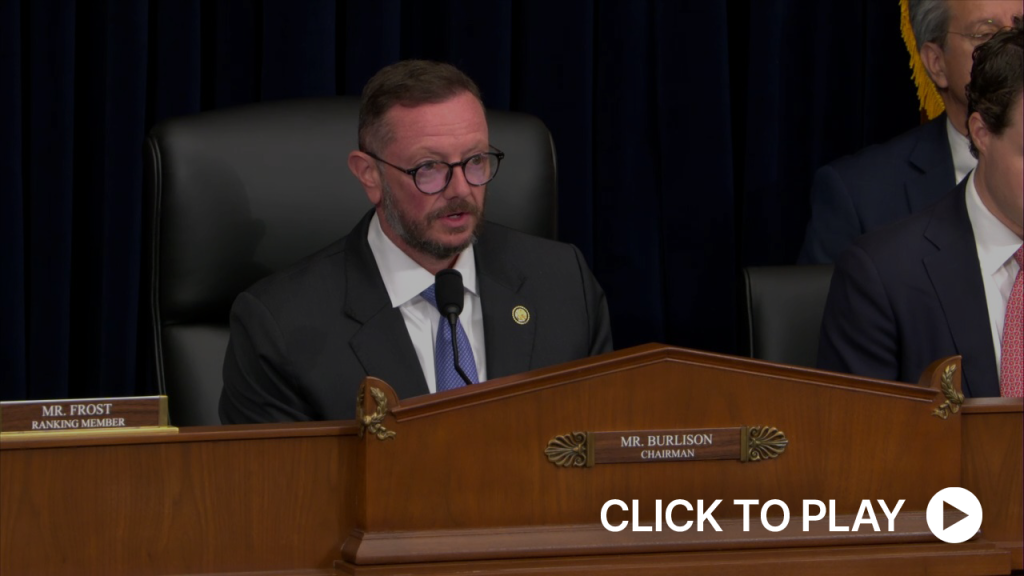
Below are Subcommittee Chairman Burlison’s opening remarks as prepared for delivery:
Good morning.
I want to welcome everyone to this hearing hosted by the Subcommittee on Economic Growth, Energy Policy, and Regulatory Affairs.
Today, the Subcommittee will examine energy choice, focusing on the consequences of bans and restrictions on the use of natural gas and other fossil fuels.
These are policies long championed by Congressional Democrats that are being pursued by blue states and localities.
High electricity costs are one of the top affordability concerns Americans have today.
Since 2020, electricity prices have skyrocketed, straining the budgets of everyday Americans.
Meanwhile, natural gas has remained an affordable and reliable form of energy for American households.
Americans across our country rely on and prefer natural gas to heat their homes, cook their meals, and often to operate their small businesses.
Natural gas is also a key component of our electrical power generation.
Over the last several years, the Biden Administration and Congressional Democrats sought to force Americans away from natural gas and other fossil fuels and towards electrification.
The Biden Administration finalized sweeping environmental regulations which pressured utilities to retire fossil fuel electric power generation capacity, straining our electric grid.
The Biden Administration also adopted a slew of burdensome regulations that aimed to ban many gas home appliances.
Additionally, the wasteful Inflation Reduction Act, championed by Congressional Democrats and the Biden Administration, poured billions of dollars into incentivizing electrification.
At the Subcommittee’s previous proceeding, we discussed how such policies play into the strengths of our foreign adversaries and fail to benefit working Americans.
Congressional Republicans have successfully repealed a number of these regulations and repealed the IRA’s wasteful spending.
The Trump Administration is likewise rolling back appliance-killing standards and regulations that aim to eliminate fossil fuel fired power generation.
And courts have overturned the Biden Administration’s natural gas-powered appliance bans, calling them attempts to make home appliances “more expensive and less useful.”
However, to help achieve their nationwide aims, Democrat-led states and localities, spurred on by radical climate activists, are implementing their own bans on natural gas in many types of buildings.
For example, the city government of Washington, D.C., our nation’s capital, plans on implementing at the end of the year a ban on natural gas in new commercial buildings, certain newly constructed residential buildings, and large renovations.
This is highly concerning, and I hope that this Committee can do something about it.
Our federalist system of course gives states the authority to make laws—including bad laws—governing intrastate energy.
In fact, when I was a Missouri state senator, I led and passed legislation to ensure Missourians were not subject to natural gas bans or other limitations to energy choice.
However, these sorts of bans have broader effects beyond just those states.
These bans are being litigated in the courts, with the Ninth Circuit ruling that federal law pre-empts states’ building code restrictions on energy sources.
These bans are projected to massively increase electricity demand, shifting the entire energy demand burden for heating and cooking during the winter months to an already stretched power grid.
Such bans will not only raise energy prices in the states in which they are enacted, but they also will increase demand for electricity from neighboring grids and regional transmission organizations, raising already-high prices in other states.
Importantly, these bans will hurt families, particularly poor families, who are struggling with their energy bills.
Additionally, natural gas bans will limit appliance choice for many American families, increasing costs and altering the broader appliance marketplace.
They will also make housing construction more expensive, exacerbating the existing home affordability crisis which is well documented to spill over from one state into other states.
According to analysis from the National Association of Home Builders, in colder climates, full electrification adds $15,000 to the cost of constructing a new home.
During this past winter, nationwide, households with electric heating saw average seasonal bills of more than $1,220 to keep their homes warm, compared to just over $700 for homes heated with natural gas.
Additionally, the American Gas Association estimates that households save more than $66 per month when using gas versus electric appliances.
Republicans believe in energy choice, appliance freedom, and energy affordability.
Democrats are trying to ban reliable and affordable energy sources like natural gas and force green energy mandates upon Americans to satisfy radical climate activists.
While these various blue state policies may seem isolated, these mandates are really a coordinated nationwide effort to work around Democrats’ failures to impose such mandates at the federal level.
Simply put—a national workaround dressed in local clothing.
At a time of sky-high electricity prices and increasing threats to the reliability and security of America’s electric grids, the last thing the American people need is a wave of natural gas bans.
Legal Disclaimer:
EIN Presswire provides this news content "as is" without warranty of any kind. We do not accept any responsibility or liability for the accuracy, content, images, videos, licenses, completeness, legality, or reliability of the information contained in this article. If you have any complaints or copyright issues related to this article, kindly contact the author above.
